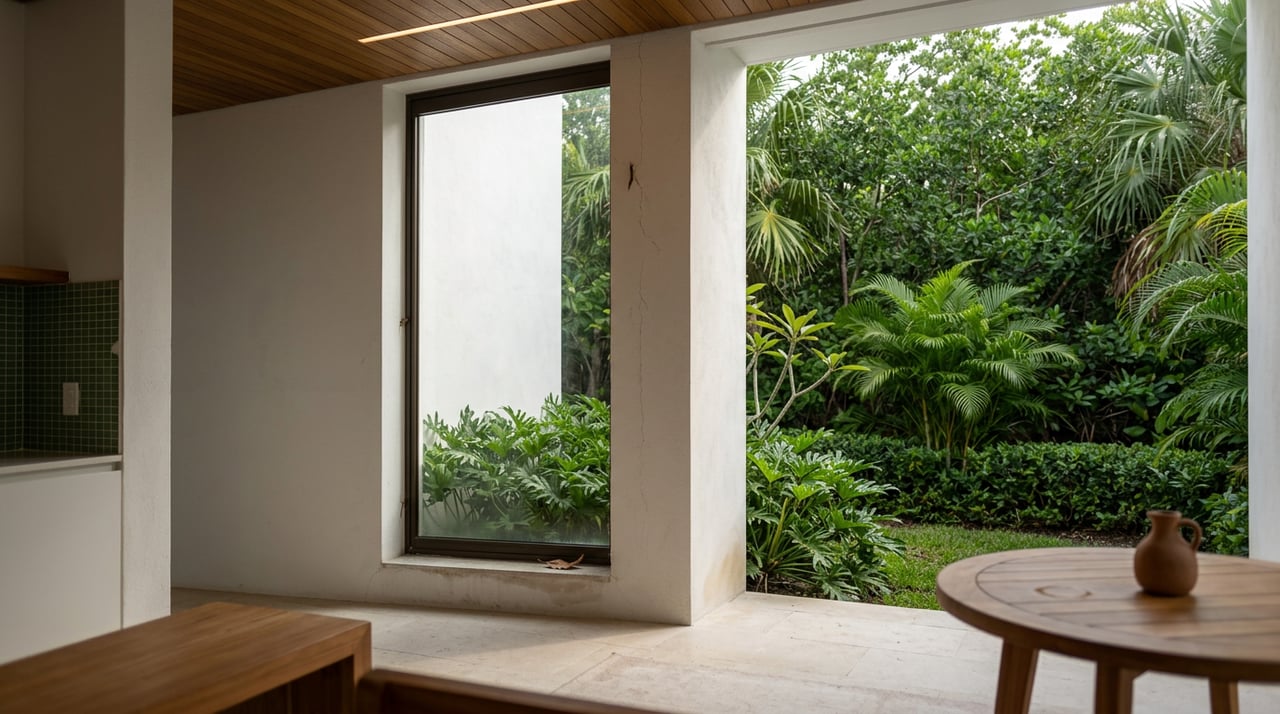
The lagoon you see out your window this morning is not reporting on today's weather. It is reporting on May's. Researchers who mapped the hydrometeorology of Laguna Bacalar over two decades found that water levels here run on roughly a two-month delay behind the regional rainfall that feeds them, because the lagoon is almost entirely groundwater-fed through the Yucatán's karst aquifer rather than surface runoff. That single fact reorganizes almost everything a resident thinks they know about the summer calendar.
Most guides frame the June-to-October window as a subtraction from the December postcard. Hotter, greener, cloudier, less blue. That framing is written for the visitor who arrives for four days and books by color. For someone who lives on the water, the more useful question is a different one: what is the lagoon actually doing this week, who is competing for it, and where does the day open up when the pulse of arrivals from the Tren Maya station north of town hits its peak.
What the Water Is Doing Right Now
The color shift residents notice in July has two overlapping causes, and separating them matters. The first is optical. Overcast skies flatten the contrast between the sandy shallows and the deep channels, so the seven-color gradient the town is named for compresses toward a single mid-blue. The second is biological and chemical. Rain that fell in May pushes through the limestone platform, arrives now, and carries with it whatever agricultural runoff and sediment it collected on the way. Agriculture upstream, aging drainage in the town itself, and the intensifying pulse of visitors all show up in the water at the same time each summer.
The most honest weekly signal is not Instagram. It is the citizen water-quality traffic light run by Agua Clara Ciudadanos por Bacalar, the civil-society group that has been monitoring the lagoon out of a small office on the Cancún–Chetumal highway since 2019. Their monitoring, combined with a decade of research from El Colegio de la Frontera Sur in Chetumal, has been clear that the water quality is not optimal anywhere in the lagoon, and that mangroves, stromatolites, and the endemic chivita snail do the biological work of keeping it drinkable-clear when the built environment does not.
"The water from both poles converges in the center of the lagoon and flows out through the Pirates Channel to Chetumal Bay."
That flow map is the key to picking a swim spot in July. Water entering from the south at Xul-Ha comes cleanest, because it is the aquifer output. Water entering from the north carries surface flow from Noh Bec, Chacchoben, and San Felipe Bacalar, which means more sediment after a storm. The docks on the south end of town clear faster after a rain than the ones north of the plaza. Residents who swim daily already know this in their legs. Newer arrivals often do not.
Reading the Weekly Tide
The Tren Maya's Bacalar station sits a few kilometers north of town, connected to the ADO terminal by an official intermodal shuttle that runs 25 pesos and about ten minutes each way. Since the Tulum-to-Bacalar section came online, the town has been absorbing a predictable daily wave of arrivals timed to the train schedule rather than to the airport transfer patterns of the past. The result is a weekly rhythm that a resident can actually plan around.
- Wednesdays: Boat tours on the lagoon are suspended for conservation. The overflow lands at Los Rápidos, which becomes the single most crowded piece of water in the municipality by mid-morning. It is the day to stay off Highway 307 south and to walk the plaza in the evening instead.
- Sunday afternoons: Costera 28 is closed. The 5 PM sunset table people plan for on other days does not exist. Casa Hormiga and Siete at Boca de Agua both stay open, and both are quieter than any Saturday of the year.
- Weekday late lunches: The 2 to 4 PM window is when the town belongs to the people who live in it. Train arrivals cluster earlier, and the outbound wave has not yet formed. Reservations that require three weeks in December can often be walked into in July if the timing is right.
- Sunrise on the water: Wind on the lagoon builds through the morning and settles in by around 10 AM. Anything requiring flat water, kayak, paddleboard, glass surface photography, has to happen before then. This is a year-round rule, but summer's afternoon storm cells make the morning window narrower and less forgiving.
Where Residents Actually Eat When Everyone Else Is Gone
The food scene has moved faster than any other part of the town over the past three years. Chefs who trained in Michelin-star kitchens now run restaurants here. Two hotels, Boca de Agua and Casa Hormiga, hold Michelin Keys from the Michelin Guide. Prices have risen 40 to 60 percent since 2020 at the waterfront places, and no longer count as budget for anyone. What has not changed is that the block behind the main plaza still holds the sub-150-peso lunches, and the taco stands still open when the rain stops.
Costera 28, run by Chef Carlos Mendez on the lagoon front, opens at 5 PM and is the closest thing the town has to a destination tasting-menu kitchen. The four- and eight-course menus are what to book when someone from out of town wants the full argument for Bacalar as a food place. Casa Hormiga's breakfast is worth the walk even for people who do not stay there. Siete, the two-story restaurant at Our Habitas Bacalar's neighbor Boca de Agua, was built into the jungle canopy on pilings that do not penetrate the soil, part of the Frida Escobedo–designed property that runs a membrane bioreactor with zero wastewater discharge into the lagoon. It is the rare high-end room in town where the ecology of the meal matches the ecology of the view.
For the rest of the week, the working list is shorter and more local. Mr. Taco for stews and fish tacos. Madre Masa for the bakery counter in the morning. Heladería Annie Delicias on the central square for the mint chip that has become the informal town dessert. 6 Hermanos for the late burger. La Catrina across from the lagoon when the live music matters more than the food. Quesadillas Estilo Orizaba behind the plaza when it does not. The public docks, Muelle 18 in the center of town, Balneario del Fondo north of the plaza, and Balneario Ejidal Mágico on the south side, still work as they always have, and the last one is where residents with kids actually spend Saturdays.
The Inland Plan B
When the lagoon goes green and the wind kicks up in the afternoon, the answer for a resident is not to stay inside. It is to move inland. Cenote Azul, five kilometers south of town, holds its color regardless of what the lagoon is doing, and entry runs 65 to 100 pesos. The no-sunscreen rule means going before the sun is overhead. The Fuerte de San Felipe, open Tuesday through Sunday for 65 pesos, is a genuine 18th-century fortress rather than a reconstructed one, and its museum covers the pirate raids and Caste War history that most residents pass without ever entering.
Farther out, the archaeological sites that the Tren Maya now serves are within a manageable half-day. Chacchoben, twenty kilometers from Limones, sits in the jungle with a fraction of the crowds of the coastal ruins. Ichkabal, closer to Bacalar, spans more than thirty square kilometers with structures reaching forty-six meters. Both work as afternoon plans on a day the water is uncooperative and the plaza is full of day-trippers.
Bacalar in July is not the winter version with the color turned down. It is a different town operating on a different clock, and the residents who understand its lag, its flow map, and its weekly tide get more use out of the lagoon in the low season than most visitors do at the peak. If you are thinking about what it means to live here year-round rather than book here for a week, Riviera Maya Homes works with buyers who want to understand the calendar of the place before they understand the price of the house. Schedule a personalized consultation when you are ready to talk about what a summer-first Bacalar week actually looks like from your own dock.