Wondering whether an Isla Mujeres property should feel more like your private getaway or operate more like a hospitality asset? That is one of the most important choices you can make before you buy on the island. If you understand how a condo-hotel and a traditional condo differ in ownership, use, and day-to-day control, you can choose a property that actually fits your goals. Let’s dive in.
Why this choice matters in Isla Mujeres
Isla Mujeres is not just a residential market. It is a tourism-led island market, which means many buyers are balancing lifestyle use with rental potential.
That makes the condo-hotel versus condo decision especially important here. In DataTur’s January through November 2024 hotel report, Isla Mujeres showed an average of 1,639 daily available rooms, 786 occupied rooms, and 48.0% occupancy. Those figures help frame the market as one where hospitality performance and owner use often intersect.
Access also shapes the ownership experience. According to Quintana Roo’s port authority, the Puerto Juárez-Isla Mujeres ferry route is the municipality’s main connection for residents, workers, and visitors, so island logistics are part of daily life for owners, guests, and service teams.
What a condo-hotel means
A condo-hotel is a hybrid ownership model. You own an individual unit, but when you are not using it, you can usually place it into a rental pool managed under a pre-agreed structure.
In practical terms, this means the property often functions more like a hotel business than a purely residential building. Revenue is typically shared according to the management terms, and operations may be handled by the developer, an operator, or the condominium association.
For many buyers, the biggest appeal is simplicity. If you want a more hands-off setup with built-in rental systems and hospitality support, a condo-hotel can be a strong fit.
Condo-hotel features you may see
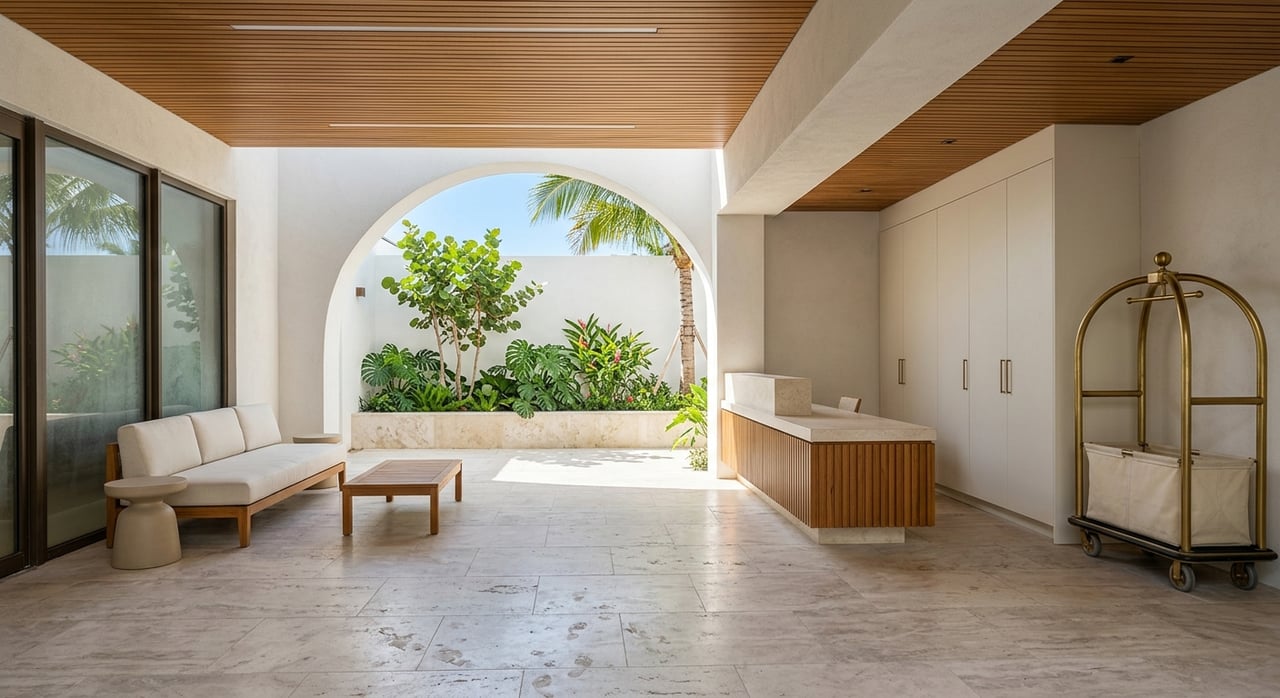
In Isla Mujeres, existing projects help illustrate what this model can look like. Some hotel-style properties on the island offer amenities such as:
- 24-hour front desk service
- Restaurant and bar service
- Pool and gym access
- Laundry facilities
- Beach towels and umbrellas
- Transportation support
- Daily maid service
- Activity coordination
- Golf cart rental assistance
- 24-hour security
These service packages matter because they shape both the guest experience and your ownership experience. They can also support a more turnkey rental setup for buyers who do not want to manage every detail themselves.
The tradeoff with condo-hotels
Convenience usually comes with less control. Personal-use schedules, furnishings, operating standards, and participation rules are often defined by the project documents and operator agreement.
That means you should look closely at the contract before you buy. A condo-hotel may be ideal if you value ease and hospitality services, but it may feel restrictive if you want to use the property whenever you want or run rentals on your own terms.
What a traditional condo means
A traditional condo in Quintana Roo sits within a broader residential legal framework. Under the state’s condominium law, condominiums may be habitational, commercial or service, industrial, or mixed-use.
For buyers, the key advantage is usually flexibility. The law states that an owner can rent or sell the unit without needing approval from other owners, subject to the law itself, the escritura constitutiva, and the condominium regulations.
That can make a traditional condo a better match if you want more personal use and more say in how the property is used. You may also have more freedom to choose your own management approach, depending on the building rules.
Traditional condo rules still matter
More flexibility does not mean no restrictions. The condominium declaration and regulations can still set rules around unit use, common areas, administration, maintenance, reserve funds, conduct, hours, insurance, late fees, guest behavior, and rental strategy.
In other words, a traditional condo can give you more autonomy, but the actual level of freedom depends on the documents. You should never assume that a unit is unrestricted just because it is not labeled a condo-hotel.
Condo-hotel vs condo: the simplest decision rule
If you want the short answer, it comes down to how you plan to use the property.
Choose a condo-hotel if you want
- Hotel-style amenities and services
- Minimal involvement in daily operations
- A built-in rental channel
- A more turnkey ownership experience
- A property designed to function partly as lodging
Choose a traditional condo if you want
- More personal use of the property
- More autonomy over scheduling and occupancy
- More control over rental or management arrangements
- A home-first ownership experience
- Flexibility shaped by building rules rather than hotel operations
Ownership structure matters early
For international buyers, the legal structure is part of the decision from the start. Mexico’s Secretaría de Relaciones Exteriores states that foreigners cannot hold direct title in the coastal restricted zone and instead generally acquire rights through a fideicomiso for use and enjoyment of the property.
The trust is generally established for up to 50 years, and the contract is executed in a public deed. In Isla Mujeres, this means title and closing mechanics should be part of your evaluation before you compare amenities or projected rental income.
If you are deciding between two properties that seem similar on the surface, their trust structure and legal documents may create very different ownership experiences. This is one reason cross-border buyers benefit from a careful, document-first review.
The documents that really decide the deal
A brochure can be appealing, but it is not the legal source of truth. What matters is how the property is actually structured on paper.
Before you decide between a condo-hotel and a traditional condo in Isla Mujeres, review these items carefully:
- Title or fideicomiso structure
- Condominium declaration
- Condominium regulations
- Hotel-management or rental-pool agreement, if applicable
- HOA fees
- Reserve fund structure
- Owner-use limits
- Unit-use definitions
- Common-area rules
- Administrator or operator responsibilities
These documents determine whether the property behaves like a second home, a rental asset, or something in between. They also help you understand where your control begins and ends.
Presale buyers should be extra careful
If you are considering a new or presale project, the need for document review becomes even more important. In Quintana Roo, the condominium regime is tied to municipal approvals and construction documentation.
That means marketing materials should not be treated as the final word on what you are buying. The legal and construction documents are what define the project, the ownership regime, and the operating rules.
How to match the property to your goals
The best purchase is not the one with the longest amenity list. It is the one that fits how you want to use the property and how involved you want to be after closing.
If you picture arriving to a staffed property with hospitality support and a ready-made rental structure, a condo-hotel may align with your goals. If you picture longer personal stays, more flexibility, and more direct control, a traditional condo may be the better fit.
In Isla Mujeres, that difference matters because the island naturally attracts both lifestyle buyers and return-minded buyers. A smart decision starts by being honest about whether you are buying a vacation home, a managed lodging asset, or a blend of both.
If you want help comparing documents, evaluating owner-use rules, or weighing lifestyle value against rental structure, Riviera Maya Homes can guide you with clear, local, cross-border insight.
FAQs
What is a condo-hotel in Isla Mujeres?
- A condo-hotel in Isla Mujeres is a hybrid model where you own an individual unit and may place it into a managed rental pool when you are not using it, usually under operator-defined terms.
What is a traditional condo in Quintana Roo?
- A traditional condo in Quintana Roo is a unit within a condominium regime governed by state condo law, the escritura constitutiva, and the building regulations, often offering more personal-use flexibility.
Which is better for rental income in Isla Mujeres, a condo-hotel or condo?
- A condo-hotel may offer a built-in rental structure and hands-off operations, while a traditional condo may offer more control, so the better option depends on your goals and the exact property documents.
Can foreign buyers own coastal property in Isla Mujeres?
- Foreign buyers in Isla Mujeres generally acquire rights through a fideicomiso in the restricted coastal zone, with the trust generally established for up to 50 years and executed in a public deed.
What documents should buyers review before buying in Isla Mujeres?
- You should review the fideicomiso or title structure, condominium declaration, building regulations, rental or hotel-management agreement, HOA fees, reserve funds, and any owner-use limits before making a decision.
Are presale condo projects in Quintana Roo different from completed properties?
- Yes. For presale projects, municipal approvals and construction documentation are especially important because marketing materials do not replace the legal documents that define the condominium regime and ownership terms.